

What Are the Latest BIS Certification Requirements for Italian Manufacturers in 2026?
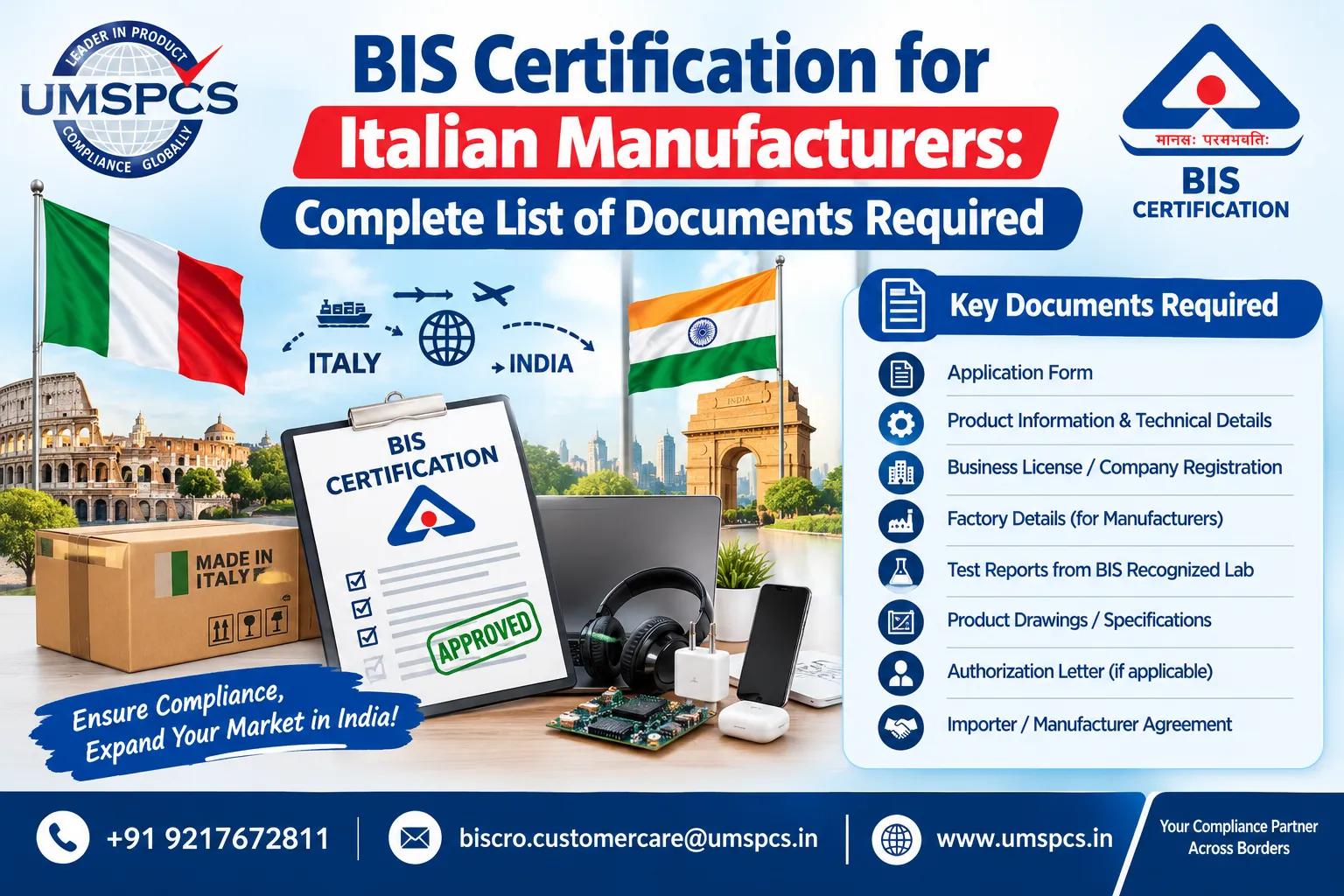
BIS Certification Requirements for Italian Manufacturers
Italy has built its name on design, engineering and finish. Whether it is a machine from Lombardy, a kitchen appliance from Veneto or ceramic tiles from Emilia-Romagna, Italian products travel well. India is an attractive market for these goods, but every shipment has to pass one gate first: the Bureau of Indian Standards. If you plan to sell in India this year, the BIS Certification Requirements for Italian Manufacturers are not something to leave for later. At UMSPCS, we see Italian companies lose months because they started late or assumed a European conformity mark would be enough. It is not.

Why BIS Certification Matters More in 2026
BIS works under the BIS Act, 2016, and the government keeps adding products to the list that cannot be imported, sold or stocked without a valid licence or registration. These rules come as Quality Control Orders (QCOs), and the list now reaches electrical goods, consumer electronics, steel products, cookware and safety items.
For Italian exporters, the result is simple. If your product falls under a QCO and you lack the right approval, customs will hold the consignment, and often send it back. Enforcement is also tighter this year. Audits are more detailed, paperwork is checked closely and online filing is the normal route. That is why the BIS Certification Requirements for Italian Manufacturers need a proper plan, not a last-minute scramble.
Two Routes: FMCS and CRS
Most Italian companies end up on one of two schemes, depending on what they make.
Foreign Manufacturers Certification Scheme (FMCS). This is the route for products that carry the ISI Mark, such as many industrial, building and household items. The licence is granted to your overseas factory. BIS reviews your quality system, production process and testing ability, and usually inspects the plant in Italy.
Compulsory Registration Scheme (CRS). This applies to a defined list of electronics and IT products, such as power adapters, LED lights, displays and some audio, video and office equipment. The product is tested and registered, and you receive a registration number that must appear on it.
Which scheme applies to the BIS Certification Requirements for Italian Manufacturers depends on the product and its Indian Standard. Getting this right first saves money later, because documents, testing and timelines differ for each.
The Core BIS Certification Requirements for Italian Manufacturers
Details change from product to product, but the building blocks of the BIS Certification Requirements for Italian Manufacturers stay consistent.
1. An Indian Authorised Representative (AIR). Every foreign applicant must appoint a representative in India who deals with BIS on your behalf and stays responsible for compliance. BIS now looks closely at what the AIR actually does, especially during audits.
2. Testing in a BIS-recognised laboratory. Your product must be tested against the relevant Indian Standard. Reports from labs BIS does not recognise are usually rejected, even well-known European ones.
3. Factory documentation. Expect to submit a process chart, an inspection and test plan, a list of test equipment and calibration proof. ISO 9001 supports your case but does not replace these.
4. A factory audit (for FMCS). BIS may inspect process control, raw material checks, traceability and your in-house testing. Keep production and testing records ready.
5. Fees and marking. There is an application fee, an annual marking fee and, for CRS, registration charges. Late fees or missing production returns can lead to suspension, then cancellation.
6. Correct labelling. The ISI Mark or CRS number, with the standard number and licence details, must appear as prescribed.
Read also BIS CRS Certification for Power Adaptors in India: What Every Brand Needs to Know
What Has Changed Recently
If you last looked at this process a couple of years ago, three shifts matter.
First, filing is digital. Applications, uploads and status tracking now run through online portals. That is more transparent, but also less forgiving, because one missing file can stall everything.
Second, the scope keeps moving. More categories have come under QCOs, while a few have been revised or relaxed. The list you checked last year may not be today’s list, so confirm your product against current notifications before fixing a shipping date.
Third, audits look deeper. Inspectors want to see how a factory controls its process day to day. Italian plants with strong systems usually meet the BIS Certification Requirements for Italian Manufacturers without drama, provided records match what happens on the floor.
A Realistic Timeline
Exporters always ask how long this takes. It depends on the product, how fast samples are tested and how ready your factory is. As a guide, the BIS Certification Requirements for Italian Manufacturers can take four to nine months under FMCS, while CRS registrations are often quicker. Delays almost always come from incomplete documents, test failures or slow replies to BIS queries.
Start early with your BIS Certification Requirements for Italian Manufacturers file. Work backwards from your trade fair or distributor deadline and add a cushion.
Common Mistakes to Avoid
• Relying on CE marking. CE shows conformity in Europe. BIS does not accept it as a substitute.
• Choosing the wrong scheme. Filing under CRS when FMCS applies wastes weeks.
• Weak AIR arrangements. A slow or inexperienced AIR can hold up the whole file.
• Forgetting post-licence duties. Annual fees, returns and surveillance continue after approval.
How UMSPCS Can Help
Italian exporters often tell us the hardest part is not the technical standard but knowing what BIS wants, and in what order. UMSPCS confirms whether your product falls under a QCO, chooses between FMCS and CRS, prepares documents, coordinates recognised lab testing, acts as your Indian Authorised Representative and supports you through the audit.
A short conversation about your range can save a surprising amount of time. Contact UMSPCS and we will map the BIS Certification Requirements for Italian Manufacturers against your exact products.
Frequently Asked Questions
1. Is BIS certification mandatory for all Italian products sold in India?
No. It is mandatory only for products under a Quality Control Order or listed under CRS. Check the current list before shipping.
2. Does CE marking replace the BIS Certification Requirements for Italian Manufacturers?
No. CE is a European requirement and BIS does not treat it as a substitute. Your product still needs testing to the relevant Indian Standard.
3. Do I need an Indian Authorised Representative?
Yes. Foreign applicants must appoint an AIR in India to handle communication with BIS and remain responsible for compliance.
4. Will BIS inspect my factory in Italy?
Under FMCS, a factory inspection is a normal step. CRS focuses more on product testing, though documents are still reviewed carefully.
5. How long do the BIS Certification Requirements for Italian Manufacturers take to complete?
FMCS often takes four to nine months. CRS can be faster. Document quality and test results have the biggest effect on timing.
6. What happens if I ship without BIS approval?
Goods can be held at the port or returned, and penalties may apply. Completing certification before dispatch is far cheaper.
7. Does the BIS licence need renewal?
Yes. Licences have a validity period, and annual fees and production returns must stay current to avoid suspension.